


Abstract
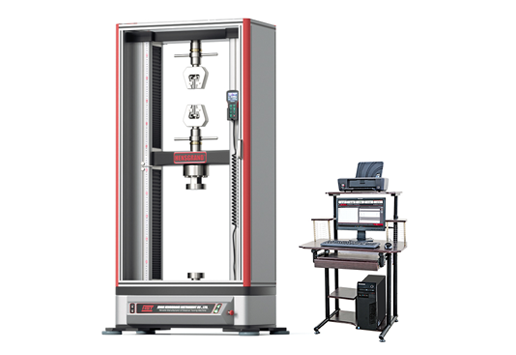
The HST WDW-100E is a 100kN, four-column Double Space electronic universal testing machine with preloaded ball-screw drive, a Class 0.5 load frame (ISO 7500-1, meets ASTM E4) and three closed-loop control modes - stress, strain and displacement. It is built for laboratories that want one frame to carry metallic tensile and bend work to ASTM E21 and EN ISO 7438, plastic and composite work to ASTM D638 and EN ISO 527-1, plus geotextile and fastener programmes - with the tensile space, test width and speed fully customizable when the standard 650mm/550mm geometry is not a match.
Key Takeaways
- 100kN capacity, Class 0.5 per ISO 7500-1, testing load accuracy ±0.5%, load range 0.4%-100%FS, resolution 1/500000FS
- Double-space four-column frame: tensile testing above the base, compression below, 1100mm crosshead travel, 650mm maximum tensile space
- Three closed-loop modes (stress, strain, displacement) with automatic, impact-free switching between them
- Standard kit includes manual wedge grips (round jaw and flat jaw sets), a φ100mm compression grip, handheld LED controller, HP computer and printer
- Reports output to Excel, Word or template format with company logo; software ships in English with multi-language support
- CE conformity under the 2006/42/EC Machinery Directive and ISO 9001 (GB/T 19001-2016) quality management are documented in the machine's certificate pack
What the HST WDW-100E is meant to decide
The WDW series covers force, displacement and deformation closed-loop testing in tension, compression, flexure, shear, tear and peel. On the HST WDW-100E, the documented test programme spans three families:
- Metallic materials: tensile testing at ambient temperature (ASTM E8, ISO 6892, BS EN 10002-1), elevated-temperature tensile (ASTM E21, ISO 783) with the series' thermal cabinets, flexure (EN ISO 7438), threaded fasteners (ASTM F606, SAE J429) and blind rivets (ISO 14589)
- Plastics and composites: tensile (EN ISO 527-1, ASTM D638), compression (ISO 604, ASTM D695, EN ISO 844), ring stiffness and flexibility on thermoplastic pipes (EN ISO 9969, EN ISO 13968, EN ISO 6259), in-plane shear of reinforced plastics (ASTM D3846) and flexural properties of composites (ISO 14125)
- Geotextiles and webbing: wide-width tensile (BS EN ISO 10319), strapping (ASTM D3850), textile slings (JBT 8521 / EN 1492-2) and breaking strength of webbing, tape and braided material (ASTM D6775-02)
That breadth is what makes a Material Tensile Compression Tester like the WDW-100E the backbone machine in inspection departments, universities and technical supervision bodies - the same frame that runs a steel bar today runs a geotextile roll next week.
Why one frame should carry the whole programme
Separating tension, compression and bending across three benches multiplies calibration, space and software licensing. A 100kN double-space frame concentrates the load path: the same 100kN Load Cell, calibrated within 0.5% accuracy as per ASTM E4, ISO 7500-1, EN 10002-2, BS1610 and DIN 51221, serves every standard test on the list above. When a receiving-inspection team re-reads a curve, every data point traces back to one calibrated frame - which is exactly what the documented ISO 9513 / BS 3846 / EN 10002-4 strain-compliance class asks for.
How a test is set up and run on the WDW-100E
Clamping and loading
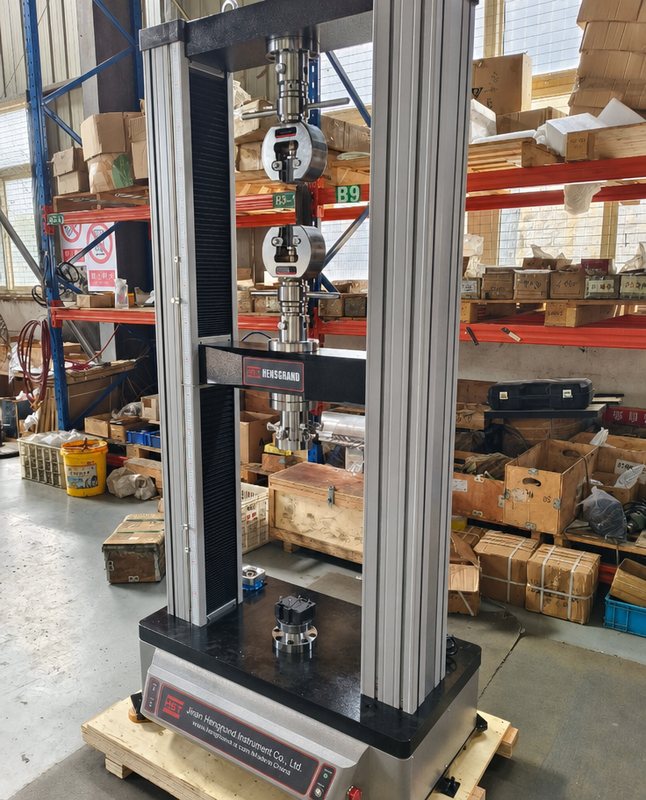
The standard manual wedge tensile grip (Code 945) uses inclined self-locking jaw wedges with a rotating handle, and ships with two jaw sets: round jaw for φ4-φ9mm round specimens (option φ9-φ14mm and φ14-φ20mm) and flat jaw for 0-7mm thick sheet (option 7-14mm and 14-20mm). For compression, the standard φ100mm compression test grip (Code 1087) sits on the lower platen of the double-space frame, so tensile and compression specimens never share the same working position.
Mode, speed and closed loop
Three closed-loop modes - stress, strain and displacement - switch automatically without impact. Constant force control runs from 0.001 to 0.50FS/s with accuracy within ±2% of set value below 0.05%FS/s and within ±0.5% above it; constant deformation control runs 0.005 to 0.5%FS/s on the same tiers. Crosshead speed spans 0.001 to 500mm/min with accuracy within ±0.5% of the value, and a preset speed row (0.001-1000mm/min) sits directly on the software panel.
Safety stops
The machine stops automatically when the change in test force exceeds a specified value, dual over-travel limits on the front console prevent crosshead overshooting and sensor overloads, and a graduated rule along the column lets the operator preset those limits to specific distances. Limit indicator lights signal the upper and lower electronic limits, and the control box carries the emergency stop.
Reading the data: what the software gives you back
The English software (other languages optional - the debug toolbox ships English, Chinese, Polish and Turkish) displays load, peak value and displacement on 5-digit figures and extension on 4 digits, and the built-in test methods cover GB, ASTM, DIN, JIS and BS specifications. From a single tensile run the automatic analysis block returns Rm, ReH, ReL, Rp, E, A and Z with per-sample and average rows - the same structure as the ISO 6892 report shown in the documentation.
Curve tools support reappearance, amplification, reduction and lapping (overlay) of curves, range-limited print, and point-coordinate observation, so a reviewer can re-read any stored run. Test data is stored in a database as text files, reports export to Excel, Word or an editable template format, and the company logo and name can be embedded. Multi-level identity management assigns different operator rights, and the controller's 3-channel 24-bit A/D plus 0-2MHz pulse / ±10V analog outputs keep the frame compatible with servo valves and external actuators.
Specifications
Measurement
- Model: HST WDW-100E
- Load capacity: 100kN
- Calibration standard: Class 0.5 according to ISO 7500-1, meets ASTM E4
- Testing load accuracy: ±0.5%
- Testing load range: 0.4% - 100%FS
- Load resolution: 1/500000FS
- Deformation measuring range: 0.2% - 100%FS
- Deformation accuracy: ≤±0.5%
- Deformation resolution: 1/500000FS of maximum deformation
Control
- Test control modes: three closed loop - stress, strain and displacement
- Constant force control range: 0.001 - 0.50FS/s (accuracy: ±2% below 0.05%FS/s; ±0.5% above)
- Constant deformation control range: 0.005 - 0.5%FS/s (accuracy: ±2% below 0.05%FS/s; ±0.5% above)
- Crosshead speed range: 0.001 - 500mm/min, accuracy within ±0.5% of the value
- Displacement accuracy: within ±0.5% of the value; resolution 0.04μm
Main frame
- Structure: four columns, double ball-screw, double space (up tensile, down compression)
- Testing space (crosshead travel): 1100mm
- Maximum tensile testing space: 650mm
- Test width: 550mm
- Overall dimensions: 948 x 660 x 1978mm
- Weight: about 680kg
- Power supply: 1kW, AC 220V ±10%, 50Hz/60Hz
- Customization: extra wide and/or extra height frames, power supply system, tensile space, test width and speed are completely customizable
Selection guide: fitting the frame to the programme
The HST WDW-100E is the right fit when the daily queue mixes ambient-temperature metal and polymer work at or below 100kN. When the programme points elsewhere, the documentation gives a clear route:
- Loads above 100kN: step up within the WDW family - the CE certificate lists WDW-500, WDW-600 and WDW-1000 frames within the same certified product line
- Elevated-temperature tensile (ASTM E21, ISO 783): the WDW series takes thermal cabinets, and HST also lists a dedicated high and low temperature tensile test machine when the programme is hot-only
- Very long or very wide specimens: order the extra tensile space, test width or frame height as a customization rather than overbuying capacity
- Cyclic or fatigue loading: that is the Fatigue Testing Machine family, not the WDW - the two complement each other in the same lab
Standards and compliance
- Load capability: ASTM E4, ISO 7500-1, EN 10002-2, BS1610, DIN 51221
- Strain measurement: ASTM E83, ISO 9513, BS 3846, EN 10002-4
- Metallic test methods: ASTM E8, ISO 6892, BS EN 10002-1 / -5, ASTM E21, ISO 783, EN ISO 7438, ASTM F606, ISO 14589, SAE J429
- Plastic and composite test methods: EN ISO 527-1, ASTM D638, ISO 604, ASTM D695, EN ISO 844, EN ISO 9969, EN ISO 13968, EN ISO 6259, ISO 14125, ASTM D3846
- Geotextile test methods: BS EN ISO 10319, ASTM D3850, JBT 8521 (EN 1492-2), ASTM D6775-02
- Safety directives: European CE Health and Safety Directives including EN 61010-1 and 73/23/EEC
- Certificates in the documentation pack: CE attestation of conformity under 2006/42/EC Machinery Directive (Annex VIII, UDEM, covering the HST testing-machine range including the WDW series) and a GB/T 19001-2016 / ISO 9001:2015 registration for production and sales of testing machines
Total cost of ownership
A 1kW draw on AC 220V (50/60Hz) keeps the machine on an ordinary laboratory circuit, and the HP computer, printer, control system and handheld unit all ship inside the standard kit. Consumables concentrate on grip jaws - the round jaw (φ9-φ14mm, φ14-φ20mm) and flat jaw (7-14mm, 14-20mm) extension sets - plus the optional three-point bending fixture (Code 501), safety shield (Code 1692), electronic extensometer (Code 958, 50mm gauge length) or USA Epsilon 3542-series Extensometer (Code 1093) as the programme grows.
Standard configuration and documentation
- 100kN four-column, two-ball-screw frame host, double space (up tensile, down compression) - 1 set
- AC servo control system (Taiwan DELTA) and reducer gear - 1 set each
- Rubber shock-absorbing pads - 4 sets
- 100kN load cell, calibration within 0.5% accuracy per ASTM E4, ISO 7500-1, EN 10002-2, BS1610, DIN 51221 - 1 set
- Closed-loop control system (force, displacement, deformation), USB connection to computer - 1 set
- English operation software (other languages optional) - 1 set
- Handheld unit controller with 320 x 240 LED display - 1 set
- HP computer and printer - 1 set
- Manual wedge tensile grip (Code 945) with round and flat jaw sets, compression test grip (Code 1087, φ100mm)
- Operation manual, certificate of conformity, packing list
Frequently Asked Questions (FAQ)
1. Which control modes does the HST WDW-100E support?
Three closed loops - stress, strain and displacement - with automatic impact-free switching, and the controller adds constant-stress and constant-strain channels on top.
2. Can the same frame do tensile and compression work?
Yes. The double-space layout puts the tensile grips above the base and the compression grip (standard φ100mm platens) below, with 1100mm of crosshead travel.
3. How are elevated-temperature tensile tests (ASTM E21, ISO 783) handled?
The WDW series is equipped with thermal cabinets for elevated-temperature programmes; for a hot-only workload, HST also lists a dedicated High and low temperature tensile test machine.
4. What grips come with the machine, and what can be added?
Standard: manual wedge tensile grip with round jaw (φ4-φ9mm) and flat jaw (0-7mm) sets, plus the φ100mm compression grip. Add-on: round jaw φ9-φ14mm and φ14-φ20mm, flat jaw 7-14mm and 14-20mm, three-point bending fixture, and electronic or USA Epsilon extensometers.
5. What power supply and floor space does it need?
1kW on AC 220V ±10% (50/60Hz). The frame occupies 948 x 660mm of floor at 1978mm height and weighs about 680kg; the power supply system is customizable where the laboratory standard differs.
6. Which report formats and languages does the software produce?
Excel, Word or editable template reports with test curve, standard reference and company logo. Software ships in English; Chinese, Polish and Turkish are available, and additional languages can be added.
HST GROUP - Focus In Material Test. Kindly contact HST Group via WhatsApp at +86 15910081986.