



Abstract
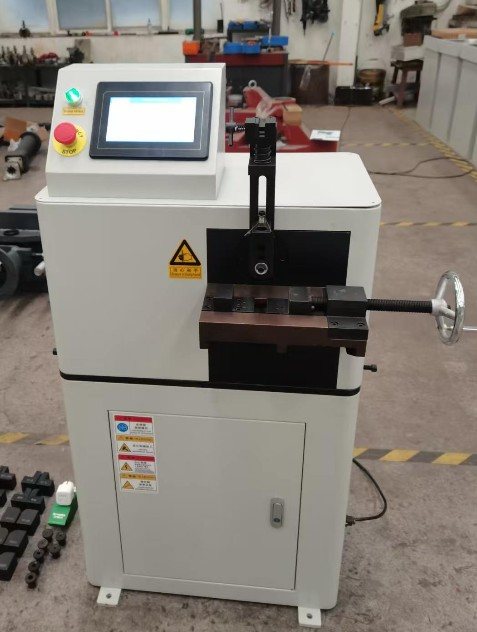
The HST JWJ-10 is a Metal Wire Reverse Bend Testing Machine that runs repeated bending tests on wires from 1 to 10mm diameter: a ±90deg bend angle at up to 60rpm, a touch screen with automatic counting up to 999,999 bends, a photoelectric detector that shuts the machine down the moment the sample gives out, and a reset-and-record cycle that leaves the bend count on the display. Seven grip pairs cover the whole diameter range out of the box, and a sheet clamping device extends the machine to sheet metal bending tests. It follows the ISO 7801, NF A03-010, DIN 51211, GOST 1579 and GB 238 methods.
Key Takeaways
- One test answers a durability question: how many reverse bends a wire survives, with the touch screen counting every cycle to 999,999.
- Seven grip pairs (Φ1-1.5 through Φ8-10mm) cover specimen diameters from 1 to 10mm without extra purchasing.
- The photoelectric switch detects the moment the specimen gives out, then the machine shuts down, resets the pendulum and records the count by itself.
- ±90deg bend angle at up to 60rpm on a two-stage reducer drive, powered by one 1.5kW 220V/50Hz motor.
- Specimen length 150-200mm; a sheet clamping device extends the same machine to sheet metal bending tests.
- Built for five wire bending methods: ISO 7801, NF A03-010, DIN 51211, GOST 1579 and GB 238.
What the JWJ-10 is for
Reverse bending - also called repeated bending - is the classic endurance check on metal wire. The machine bends a specimen back and forth, and the result is the number of cycles it stands before it gives out. That single number tells a wire producer or a buying lab how the wire performs, and where plastic deformation starts to show itself, under exactly the kind of back-and-forth loading the wire will see in service.
With the included sheet clamping device, the same machine also runs sheet metal bending tests, so a shop that checks both wire and sheet metal does not need a second frame.
Why the automatic cycle matters
The JWJ-10 closes the whole count-stop-reset-record loop by itself:
- A photoelectric switch detects the bending test count cycle by cycle, and the touch screen displays the running total as the test runs.
- The moment the sample gives out, the machine automatically shuts down - no operator reaction time to add to the result.
- The pendulum resets itself, the digital display shows the final count, and the bend count of the specimen is recorded automatically.
- The counter goes to 999,999, so long endurance runs have headroom to finish before the counter tops out.
For a lab running several samples in a row, that means the number you read off the screen is the number the test actually produced, with no transcription step between.
How a reverse bend run is set up
- Pick the grip pair for the wire: the standard kit ships seven pairs, Φ1-1.5, Φ1.5-2, Φ2-3, Φ3-4, Φ4-6, Φ6-8 and Φ8-10mm, one pair each.
- Cut the specimen to 150-200mm and clamp it in the grips.
- Set the run from the touch screen; the two-stage reducer drive applies the test torque and swings the specimen through ±90deg on every cycle, at up to 60rpm.
- Watch the automatic count climb on the display, and let the machine stop, reset and record itself when the specimen gives out.
The host is one integrated unit - mechanical system and electrical measurement and control system in a single 600 x 500 x 1200mm frame - and the included video tutorial covers installation and operation.
Reading the result
The deliverable of a reverse bend test is the bend count at the point the specimen gives out, compared against the value the standard or the customer specification requires. The JWJ-10 reports that count directly on the touch screen and records it for the report, so the lab file shows the number the machine measured rather than a copied value. For sheet metal, the sheet clamping device extends the same frame to sheet bending tests.
HST JWJ-10 specifications
Measurement
- Specimen diameter: 1-10mm (seven grip pairs: Φ1-1.5, Φ1.5-2, Φ2-3, Φ3-4, Φ4-6, Φ6-8, Φ8-10mm)
- Specimen length: 150-200mm
- Bend angle: ±90deg
- Bend frequency: less than 60rpm
- Bend times: up to 999999, automatic count
- Display: touch screen, automatic count, automatic record
Drive
- Two-stage reducer drive applying the test torque for repeated bending
- Photoelectric switch detecting the bending test count
- Automatic shutdown after the specimen gives out, automatic pendulum reset
Machine
- Motor power: 220V, 50Hz, 1.5kW
- Dimensions: 600 x 500 x 1200mm
- Weight: 230kg
Standard configuration
- Steel wire reverse bend testing machine mainframe, 1 set
- Grips, one pair each of the seven diameter ranges
- Tool kits, 1 set
- Video tutorial for installation and operation, 1 set
Selection guide: where the JWJ-10 fits
- You test metal wire from 1 to 10mm against ISO 7801, NF A03-010, DIN 51211, GOST 1579 or GB 238 and want the bend count to be automatic end to end.
- You run endurance checks in volume - the automatic shutdown, reset and record keep the per-sample operator effort down to clamping and reading the screen.
- You also bend sheet metal on the side; the sheet clamping device keeps one frame for both jobs.
- For static bending of larger bars, the Steel Bar Bending Testing Machine covers that duty - the JWJ-10 is the repeated-bend machine for wire.
- In the site catalog, the Wire Reverse Bending Testing Machine page sits in the bending machine line, while the steel wire testing machine category gathers the other steel wire testers.
Total cost of ownership
- The 1.5kW 220V/50Hz motor runs on one ordinary single-phase lab circuit.
- The drive is an electric motor through a two-stage reducer - no hydraulic system to service; routine care is grip maintenance and the ordinary upkeep of a bending machine.
- At 230kg in a 600 x 500 x 1200mm frame, the machine parks on a standard footprint and stays put once sited.
- The included video tutorial for installation and operation shortens the setup time after delivery.
Standards and compliance
- ISO 7801 - steel wire, repeated bending test method
- NF A03-010 - steel wire, repeated bending test method
- DIN 51211 - steel wire, repeated bending test method
- GOST 1579 - steel wire, reverse bending test method
- GB 238 - steel wire, repeated bending test method (China)
The product sheet does not list machine certifications for this model, so no certification claims are made here.
Frequently Asked Questions (FAQ)
1. What wire diameters can the HST JWJ-10 test?
From 1 to 10mm, with seven grip pairs in the standard kit: Φ1-1.5, Φ1.5-2, Φ2-3, Φ3-4, Φ4-6, Φ6-8 and Φ8-10mm.
2. How high does the bend counter go?
999,999 bends, counted automatically by a photoelectric switch and shown on the touch screen.
3. What is the bend angle and speed?
±90deg per cycle, at up to 60rpm on a two-stage reducer drive.
4. Can it test sheet metal as well?
Yes - with the sheet clamping device the same machine runs sheet metal bending tests.
5. What power supply does it need?
AC 220V, 50Hz, 1.5kW. The machine weighs 230kg and measures 600 x 500 x 1200mm.
HST GROUP – Focus on Material Test. Kindly contact HST Group via WhatsApp at +86 15910081986.