

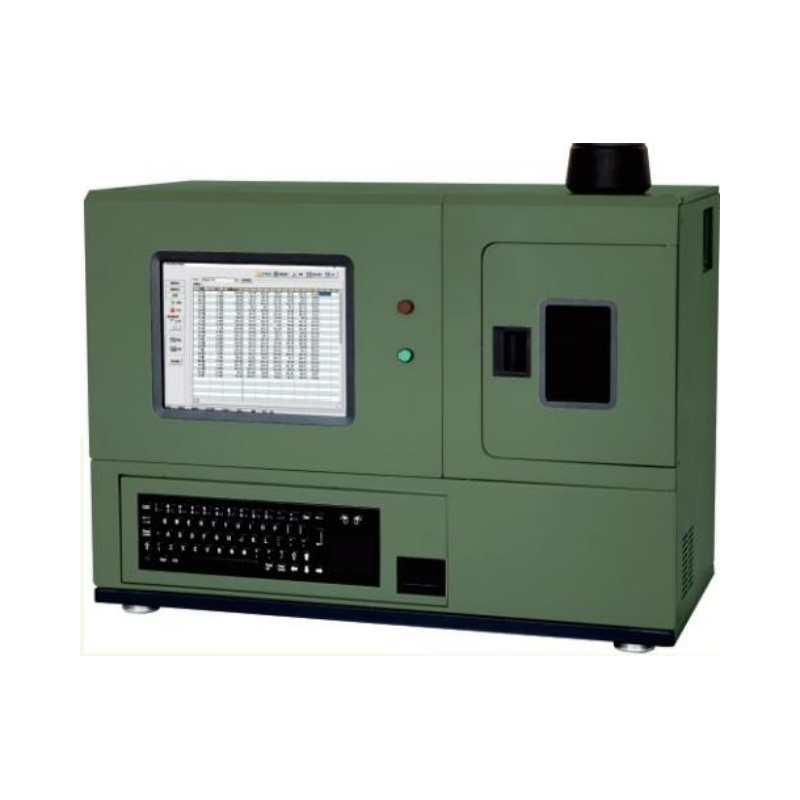

HST-AP2 Oil Spectrometer Makes Oil Analysis More Convenient
Oil spectrometers are effective tools for monitoring and analyzing oil components, directly detecting samples such as lubricating oil, hydraulic oil, and grease.
Standards:
ASTM D6595,ASTM D6728,NB/SH/T0865-2013DL/T1550-2016
Request A Quote Files DownloadHST-AP2 Oil Spectrometer
Makes Oil Analysis More Convenient
Oil spectrometers are effective tools for monitoring and analyzing oil components, directly detecting samples such as lubricating oil, hydraulic oil, and grease. By analyzing the elemental content of wear metals, contaminants, and additives in the samples, the wear level, sealing condition, overheating, and other faults in large equipment can be determined, along with the location of the fault.
Oil spectroscopic analysis assesses equipment wear by monitoring changes in the metal element content of the oil. When equipment wears, metal particles detach and enter the oil, and their increased content can be detected in the spectroscopic analysis. Furthermore, contaminants and additives in the oil also affect the spectrum, providing further information about the equipment's health status. Real-time and trend analysis of the spectroscopic data enables monitoring of equipment operating status, fault diagnosis, and early warning. When the spectroscopic analysis results show abnormalities or abnormal trends, potential equipment problems can be identified early, allowing for timely maintenance and reducing the risk and frequency of equipment failures. This facilitates proactive preventative maintenance, reduces downtime and repair costs, and ultimately lowers operating costs.
Technical Parameter:
1. Optical resolution: 0.006nm
2. Loran circle focal length: 500mm
3. Wavelength range: 190nm 900nm
4. High-performance holographic diffraction grating, grating line count 2700L/mm;
5. High-performance spark source: high repetition rate AC pulsed arc source, stable and reliable excitation process, bidirectional excitation;
6. Integrated optical chamber structure, with good shock resistance and transportability; dual independent temperature control for the optical chamber and main unit: effectively suitable for both excessively high and low ambient temperatures; optical system temperature control: 35°C±1°C, temperature settable range 25°C~50°C, effectively ensuring accuracy and stability;
7. Detectable elements: 24 elements (Ag, Al, B, Ba, Ca, Cd, Cr, Cu, Fe, K, Li, Me, M, Mo, Na, Ni, Pb, Sb, Si, Sn, Ti, V, Zn), with the option to expand to determine As, Bi, Ce. 7 elements including Co, n, W, and Z:
8. Detection repeatability (standard deviation of detection value) meets the requirements of ASTM D6595-00 (2011) standard;
9. Detection accuracy (error between the average detection value and the standard value) ±2 mg/kg (0 mg/kg~10 mg/kg) 10% (10 mg/kg~900 mg/kg);
10. Inter-instrument consistency: the percentage difference is not greater than 15% (50 mg/kg standard oil);
11. Detection limit is 0.01 ppm;
12. Instrument power consumption: <1 kW;
13. Environmental adaptability: meets the requirements of National Military Standard GJB 3947A-2009, Section 3.8, Level 4; Electromagnetic compatibility: meets the requirements of National Military Standard GJB 3947A-2009, Section 3.9.1;
14. Maintainability: MTTR ≤ 4 h (Complete component replacement method adopted); 15. Reliability: MTBE > 8000h
16. Continuous operating time ≥ 4 hours
17. Operating temperature range: 10-50°C, storage temperature range: -65-80°C, relative humidity: <95%
Relate Products