



Abstract
The HST-DTQ5 is a benchtop, low-speed precision cutting machine for sectioning high-value materials - the product sheet calls out high-value artificial crystals by name. A 0-600rpm spindle, 0.01mm positioning accuracy over a 25mm mobile-frame stroke, four included clamps and a limit switch with automatic stop are the four things it is built around, and together they make the cut repeatable, gentle and unattended. This 2026 buyer's note explains what a low-speed precision cutting machine is for, how a DTQ5 cut is set up and read, and where the model sits inside HST's range of Metallographic Cutting Machines.
Key Takeaways
- 0.01mm positioning accuracy over a 25mm mobile-frame stroke - the cut lands at the same place, run after run
- 0-600rpm spindle range: a deliberately low ceiling that suits heat- and chip-sensitive materials
- Four clamps in the box, positioning the sample at the best angle for cutting; quick clamp available as an option
- Limit switch plus automatic stop after the cut is complete - the cycle can run unattended
- 100mm diamond cutting disc with a 0.3 x 12.7mm profile, 30mm maximum cutting diameter
- 50W, 220V benchtop unit: 392 x 330 x 310mm, 19.35kg net, one crate at 33kg gross
What the HST-DTQ5 is for
The HST-DTQ5 low-speed precision cutting machine is suitable for cutting a wide variety of materials, especially high-value artificial crystals. That last phrase is the whole product position: the machine is aimed at work where the sample costs more than the time the cut takes, so the cut itself has to be cheap in material rather than in minutes.
In a crystal lab - growth facilities, device houses, semiconductor and optics suppliers - the section you cut becomes the specimen you characterise. A chip, a delaminated edge or a heat-affected band is not a scrap sample to be re-pulled from a melt; it is a loss the programme has to absorb. The DTQ5 is the sectioning step for exactly that kind of queue: small samples (up to 30mm diameter), demanding faces, and a batch rhythm that should not need a person at the handle for every piece.
Why low speed and fine positioning are the two levers
Two specifications do most of the work on this machine.
The first is the speed ceiling. A spindle range of 0-600rpm is far below the thousands of rpm a high-throughput cutting wheel spins at, and that is the point: the lower the wheel speed, the gentler and more gradual the cut, which is what heat- and chip-sensitive material wants. The 0.3 x 12.7mm profile of the 100mm diamond disc keeps the contact thin, so each pass removes a narrow line of material instead of a deep groove.
The second is the positioning. 0.01mm accuracy over a 25mm mobile-frame stroke means the machine holds the cut line the same way every time it runs. For a single cut that is a nice property; for a batch of identical crystal sections it is the property that makes the yield arithmetic work, because every piece in the batch comes out of the clamp at the same position, ready for the next step.
How a cut is set up and run
Clamp the sample
The four clamps ship in the box, and they exist to position the processed object at the best angle for cutting - the standard clamp set holds the sample from multiple directions, and a quick clamp is available as an option when the sample changes faster than a threaded clamp wants to.
Set the speed and the line
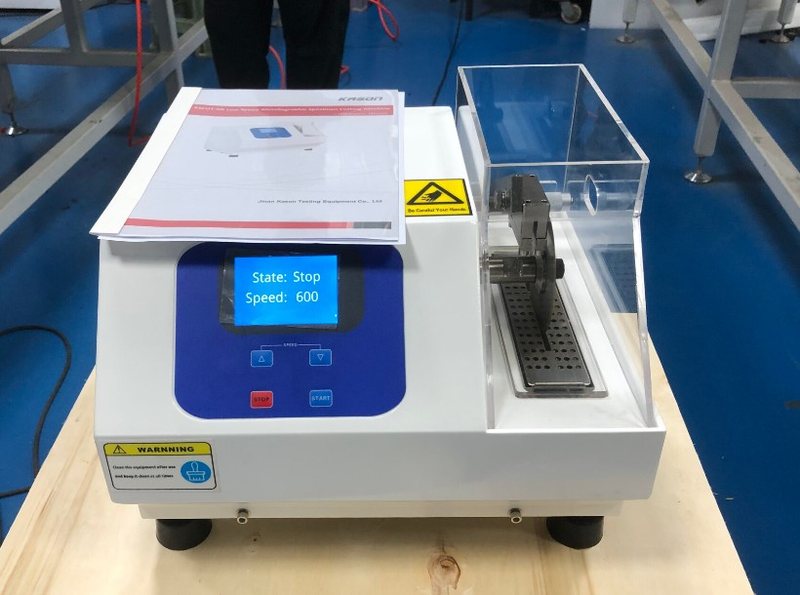
The control panel reads state and speed directly (the panel in the photo shows State: Stop with the speed set at 600), with up/down keys for the setting and start and stop buttons at hand level. The operator sets the spindle speed for the material, then fine-tunes the horizontal feeding position - the mobile frame's stroke is 25mm, which is the adjustment range the feed has to work inside.
Let the limit switch finish the job
Once the cut is running, the limit switch takes over the last step: when the cutting is completed, the operation stops automatically. That is what enables the unattended processing the machine is designed for - set the batch up, start it, and the machine stops itself piece by piece rather than waiting for someone to read the cut line through the cover.
Reading the result
The check after each batch is the cut face under the microscope - for this class of sample that is normally a Metallurgical Microscope or a crystallography rig. What the low-speed pass should give you is a clean, straight line with no chip at the entry or exit edge and no visible heat band along the kerf. Where a face still shows edge damage, the levers the DTQ5 offers are the two it is built on: drop the spindle speed inside the 0-600rpm range, and verify the positioning so the sample is not being loaded at an angle the clamp was not set for.
Specifications
Precision and feed
- Mobile frame stroke: 25mm
- Positioning accuracy: 0.01mm
- Spindle speed: 0-600 r/min
Cutting
- Saw blade: diamond cutting disc, 100 x 0.3 x 12.7mm, 1 pc supplied
- Maximum cutting diameter: 30mm
Electrical and logistics
- Power: 50W
- Voltage: 220V
- Dimensions: 392 x 330 x 310mm
- Package size: 650 x 530 x 540mm
- Net weight: 19.35kg; gross weight: 33kg
Selection guide: where the HST-DTQ5 sits
The DTQ5 is the precision end of HST's cutting range, at the 30mm class. The boundaries are clean:
- Round Metallographic stock up to 60mm is the HST-SQ60's work - a manual benchtop cutter with a 60mm maximum cutting diameter.
- Larger samples, and programmes that need automatic feed modes, step up to the HST-LDQ130Z 130mm large-sample cutter.
- High-volume repeat sectioning where the same cut runs hundreds of times belongs to the automatic cutters of the Q100 series.
- The DTQ5 is for the sample that cannot afford to be cut again: small, valuable, and cut at the bottom of the speed range rather than the top of it.
Total cost of ownership
- Running cost is a 50W draw - the electrical draw fits any standard bench outlet.
- Consumables are the diamond cutting disc (1 pc in the box, with the rest of the line available from HST's metallographic consumables range) and the clamp hardware, which the quick clamp option is there to spare.
- The 33kg gross crate is one-person-plus-a-cart territory, and the 392 x 330mm footprint fits a bench corner with no foundation work.
Standard configuration and documentation
In the box
- Low speed precision cutting machine HST-DTQ5, 1 set
- Fixtures (clamps), 4 pcs
- Diamond cutting disc 100 x 0.3 x 12.7mm, 1 pc
- Wrench 17-19mm, 1 pc; open end wrench 20mm, 1 pc
- Product manual, 1 sheet; product certification, 1 sheet
Optional
- Quick clamp, 1 set
Frequently Asked Questions (FAQ)
1. What materials is the HST-DTQ5 designed for?
A wide variety of materials, especially high-value artificial crystals - the low-speed diamond cut is aimed at samples where the material is more expensive than the time.
2. What does "low speed" mean in practice?
The spindle runs from 0 to 600rpm, a ceiling far below high-throughput cutting wheels, which is what makes the cut gradual enough for heat- and chip-sensitive material.
3. How accurate is the cut position?
0.01mm positioning accuracy over a 25mm mobile-frame stroke, so repeated cuts land at the same place across a batch.
4. Can it run without an operator watching every piece?
Yes. The limit switch detects when the cut is completed and stops the operation automatically, which the product sheet lists as enabling unattended processing.
5. What is the maximum sample size?
30mm maximum cutting diameter, on a 100mm diamond disc with a 0.3 x 12.7mm profile.
6. What power supply does it need?
220V at 50W - a benchtop draw that fits a standard laboratory outlet.
HST GROUP - Focus in Material Test. Kindly contact HST Group (Jinan Hensgrand Instrument Co., Ltd.) via WhatsApp at +86 15910081986, or by email at admin@hssdtest.com, www.hssdgroup.com.