



Abstract
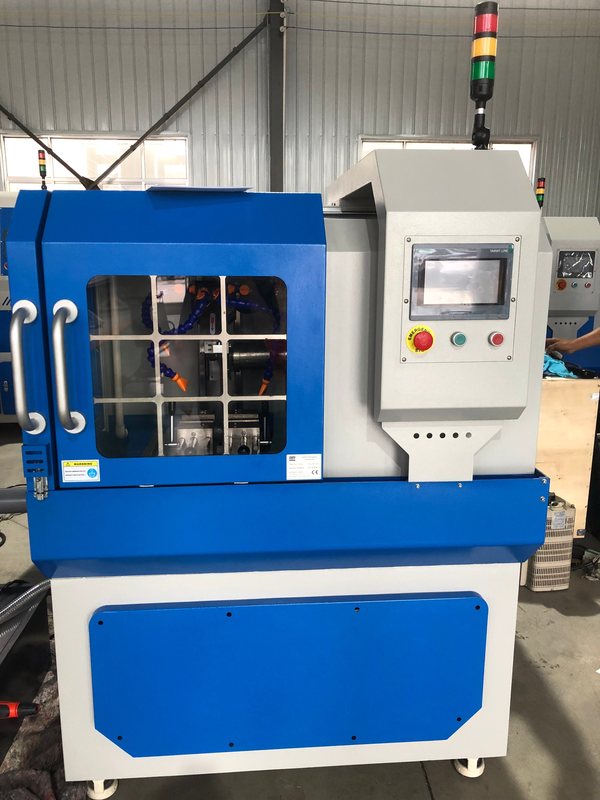
HST-LDQ130Z is a vertical, fully enclosed Metallographic Cutting Machine built for laboratories that routinely section large or heavy workpieces - it clears a maximum passing diameter of 130mm and runs on a Siemens PLC with a 7-inch touch screen. Unlike a bench-top cutter that forces you to reshape the sample before sectioning, this machine accepts the workpiece from above, front or left and holds it on a 128x320mm / 180x320mm worktable, so the metallographic section you get is the section you actually needed.
Key Takeaways
- Three cutting modes - chop cutting, push cutting and sweeping cutting - cover solid sections, long cuts and hard-material work without changing equipment.
- Cutting feed speed is adjustable from 0.01 to 1mm/s in 0.01 steps, so the rate can be matched to the hardness of each workpiece instead of the other way round.
- A maximum passing diameter of 130mm and a 400x4x32mm cutting wheel allow large workpieces to be sectioned without preliminary cutting.
- Automatic X, Y and Z control through stepper motors removes the operator-to-operator variation that hand-fed cutting introduces.
- Electromechanical separation plus waterproof isolation of the cutting room motor keeps the drive system clear of coolant and debris.
- The workpiece can be loaded from above, front or left through sliding and hinged doors, which is what makes large-part handling practical.
What this machine actually decides
Sectioning is the first irreversible step in metallography. Everything downstream - mounting, grinding, polishing, etching and the final microscopic reading - happens on the surface the cutting machine produces. If that surface is deformed, overheated or cut off-axis, no amount of later preparation recovers the true structure.
The HST-LDQ130Z decides three things for you:
- Whether the workpiece can be sectioned without being cut down first (maximum passing diameter 130mm, worktable 128x320mm and 180x320mm)
- Whether the cut plane lands where the investigation needs it (stepper-motor control of X, Y and Z, with position display and zero-clearing)
- Whether the operator's hand or the machine's feed governs the cut rate (automatic cutting speed set per material and hardness, adjustable from 0.01mm/s)
It is designed for laboratory sample preparation where large workpieces are normal - thick-walled pipe, bar stock, weld coupons, castings and heavy sections that will not fit a standard bench cutter.
Why sample cutting quality matters more than cutting speed
The cost of a badly sectioned sample rarely shows up at the cutting machine. It shows up later, as a structure that cannot be read, a re-cut that consumes another specimen, or a result that has to be thrown out and repeated because the cut surface no longer represents the material.
Three failure modes drive most of that rework, and each one is addressed by a specific capability on this machine:
- Cut surface damage from excessive feed rate. Manual feeding tends to push the wheel as fast as it will go. The automatic speed setting lets the operator set the rate according to the material, hardness and cutting thickness of each workpiece.
- Off-axis or misplaced cuts on large parts. Position is displayed per axis and can be cleared to zero, so the cut length is set against a known datum rather than estimated.
- Heat build-up in long cuts. The machine supports intermittent cutting - a cutting distance, a retreat distance and a pause time - so the wheel can leave the cut periodically instead of running continuously through a heavy section.
Notice what this machine is not doing: it is not promising the fastest possible cut. It is giving the operator independent control of speed, mode and pause, which is what determines whether the section is usable.
How a cut is set up and run on the HST-LDQ130Z
Loading the workpiece
The working area is fully enclosed with a transparent protective cover. Sliding and hinged doors give access, and the workpiece can be fed into the cutting chamber from three directions - above, front and left - which is the practical reason large workpieces can be positioned properly rather than forced in. The clamp then holds the part on the T-shaped worktable, and an oversized observation window on the safety door plus LED lighting inside the chamber let the operator watch the entire cut.
Choosing the cutting mode
Three functional cutting methods are available on the touch screen:
- Chop cutting - for fast sectioning of solid workpieces
- Push cutting - completed by Y-axis movement, controlled by the cutting distance and cutting speed in the Y-axis parameter screen. The mode can be changed there between direct cutting, intermittent cutting and forward-and-backward cutting.
- Sweeping cutting - completed by Z-axis movement, with its own parameter screen; the same direct / intermittent / forward-and-backward options apply.
For steel solid cylinders in particular, the doc-level guidance is to select the cutting method that suits the section rather than defaulting to one mode for every job.
Setting the parameters
The parameter screens cover five areas - X-axis, Y-axis, Z-axis, sweeping cutting, and I/O signal debugging - plus the cutting mode conversion buttons. The values an operator sets for each cut are:
- Manual speed - the rate for manual movement during setup
- Automatic speed - the cutting rate during automatic cutting, set according to material, hardness and cutting thickness
- Cutting distance - the stroke value used in reciprocating mode; it must be set greater than the retreat distance
- Retreat distance - the return distance in reciprocating mode; it must be set smaller than the cutting distance
- Cutting stroke - set from the cutting length of the workpiece, and must exceed the actual cutting size
- Cutting pause time - the dwell after the cutting distance is reached, which is what creates intermittent cutting
- Current position - displayed per axis, with a position clear button to return the value to zero
Cooling and cleaning
The cooling water tank is independent, and the machine is supplied with it. Coolant is required - tap water must not be used. The cutting room motor is protected by waterproof isolation, and the arrangement keeps the electrical system separated from the cutting zone. After a cut, the left flushing tap is used to clear debris from the room before the safety door is closed.
What you can watch and control while the cut runs
The design intent here is observability, and it is worth being explicit about what an operator can actually see and change mid-cut:
- The whole cutting process through the oversized window, under LED lighting inside the chamber
- The X, Y and Z position values on the main screen, alongside the cutting mode display
- The feed rate, by switching to the automatic speed setting for the material at hand
- The duty cycle, by moving between continuous and intermittent cutting via the pause time
- The mode itself, by switching between chop, push and sweeping cutting without unloading the workpiece
- System condition, through the I/O signal debugging screen, which displays device status and is the screen to open when the system reports a fault
Because electromechanical separation keeps the motor compartment separate from the cutting room, that monitoring is not a trade-off against equipment life.
Specification
| Model | HST-LDQ130Z |
| Cutting method | Chop cutting, push cutting, sweeping cutting |
| Cutting speed | 0.01-1mm/s (adjustment step 0.01) |
| Reset mode | Automatic |
| Control system | Siemens PLC, 7-inch touch LCD screen |
| Spindle speed | 2800 rpm |
| Maximum stroke | Z axis 130mm; Y axis 200mm; X axis 100mm |
| Worktable size | 128x320mm, 180x320mm |
| Maximum passing diameter | 130mm |
| Cutting piece size | 400x4x32mm |
| Cutting power | 4KW |
| Power supply | 380V/50Hz |
| Overall dimensions | 1350x1100x1750mm (length x width x height) |
Selection guide: when this machine is the wrong choice
A large-sample cutter is not the right answer for every laboratory, and it is more useful to say so plainly.
- If your specimens are small and routine - standard Metallographic samples well under 130mm - a compact bench-top metallographic cutting machine will section them faster and cost less. The LDQ130Z earns its footprint on large or awkward workpieces.
- If you need a single fixed cut length in high volume, the three-mode flexibility is more capability than the job requires; a simpler automatic cutter with fewer parameters will be easier to operate and to validate.
- If you do not have a three-phase supply, this machine will not run. It requires 380V/50Hz three-phase four-wire input.
- If the constraint is floor space, plan for 1350x1100x1750mm plus the independent cooling water tank and clearance for the sliding and hinged doors to open fully.
- If your bottleneck is not cutting at all but the steps after it, the priority purchase may be a metallographic mounting machine or a metallographic grinding and polishing machine instead.
Total cost of ownership
- Consumables are standard sizes. The machine uses 400x4x32mm wheels and two are supplied with it, so wheels are not tied to a proprietary format.
- Two wheels plus the full accessory set ship with the host - water tank with pump, drain pipe, water inlet pipe, throat hoops and wrenches - so the machine can be commissioned without a separate accessory order.
- Automatic X, Y and Z control reduces rework cost, which in a metallography lab is normally a bigger line item than wheel consumption.
- Electromechanical separation and waterproof motor isolation reduce the maintenance exposure that wet cutting rooms otherwise create.
- Coolant discipline matters. The machine requires coolant rather than tap water; treating that as a consumable rather than an avoidable cost is what protects the cut surface and the pump.
Standard configuration and documentation
Supplied with the host: water tank (with water pump) 1 set, grinding wheel 400x4x32mm 2 pcs, drain pipe 1 pc, water inlet pipe 1 pc, big throat hoop 2 pcs, wrench 3 pc, manual 1 sheet, certificate of conformity 1 sheet, packing list 1 sheet.
The machine control system is built on a Siemens PLC with a 7-inch LCD touch screen, operating from a three-phase four-wire AC380V 50Hz supply. Operation is by touch screen plus start, stop and emergency stop buttons on the panel: after power-on, the main switch is closed and the start button powers the system, while the stop button powers it down and the emergency stop halts the system.
Frequently Asked Questions (FAQ)
1. Why choose the HST-LDQ130Z metallographic cutting machine?
Because it sections workpieces up to 130mm passing diameter that bench-top cutters cannot accept, and it does so under automatic X, Y and Z control with three selectable cutting modes and feed rates adjustable from 0.01mm/s. Large-part handling is built in: the workpiece feeds from above, front or left, through sliding and hinged doors.
2. What is the difference between chop cutting, push cutting and sweeping cutting?
Chop cutting is the direct sectioning mode. Push cutting is completed by Y-axis movement and is controlled by the cutting distance and speed in the Y-axis parameter screen. Sweeping cutting is completed by Z-axis movement and uses its own parameter screen. Push and sweeping cutting can each be set to direct, intermittent or forward-and-backward cutting.
3. How do I set up intermittent cutting?
Set the cutting distance and the retreat distance, keeping the cutting distance larger, then set the cutting pause time. The machine cuts the set distance, retreats, pauses for the set time, and cuts again - which is how heavy sections are cut without running the wheel continuously.
4. Can I use tap water as the coolant?
No. The machine uses an independent cooling water tank and coolant must be used rather than tap water. After cutting, the left flushing tap is used to clear debris from the cutting room before closing the safety door.
5. What power supply does the HST-LDQ130Z require?
Three-phase four-wire AC380V 50Hz. Cutting power is 4KW. If your laboratory does not have a three-phase supply, this machine cannot be installed as supplied.
6. What happens if the system reports a fault?
The I/O signal debugging interface displays system status and shows the function of the device, its parameters and the associated precautions. When a fault is reported, that is the screen to open to identify it.
Laboratories putting together a complete sample preparation line usually sequence it as cutting, then mounting, then grinding and polishing - with metallographic consumables and coolant treated as ongoing items rather than one-off purchases. HST GROUP supplies across all three stages, so the section taken on the HST-LDQ130Z is prepared on equipment from the same source.
HST GROUP – Focus on Material Test. Kindly contact HST Group via WhatsApp at +86 15910081986.